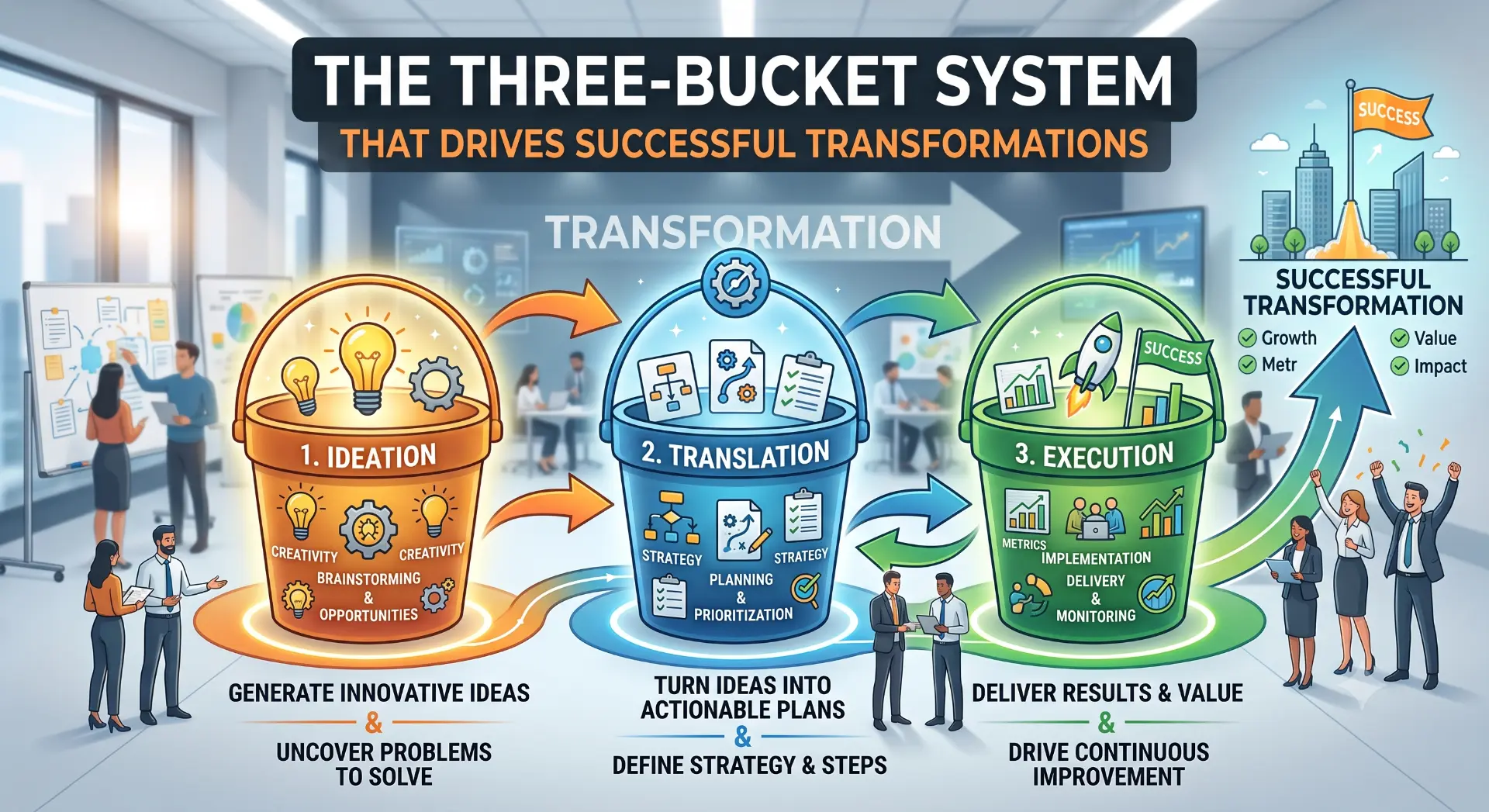
Many digital transformation initiatives fail not because the people leading them lack ambition or skill, but because the process itself is flawed.
Companies — and people — often become too attached to their own ideas, rush into building without a clear plan, or execute perfectly on the wrong goals.
Research by Boston Consulting Group in 2020 found that 70% of digital transformations fail to meet their goals. Similar findings come from McKinsey's work on broader transformation efforts. The exact percentage varies by source, but the trend is consistent.
Successful transformation programs treat change as more than a single project. They approach it like a production line with three stages: Ideation, Translation, and Execution. Skip any one of them and the whole line stalls.
Ideation: Identifying What Is Actually Broken
Ideation is not a brainstorming session with sticky notes.

The unglamorous, collaborative start — identifying real issues, not just new technology to explore.
It is about uncovering real pain points: the inefficient processes, the gaps competitors are already exploiting, and the customer complaints nobody is addressing.
Two sources feed this stage. Front-line employees and customers see the daily friction. Leadership sees where the industry is heading and what the company will need in three to five years. Neither perspective alone is enough.
The classic mistake is starting with the technology instead of the problem. "We should use AI for this" skips the essential step of defining exactly what "this" is. AI, automation, and cloud platforms are tools. The problem comes first.
Translation: Turning a Vision Into Something Buildable
This is where most transformations fail, and it usually gets the least attention.
A statement like "we need to personalize the customer journey with AI" means almost nothing to a product owner.
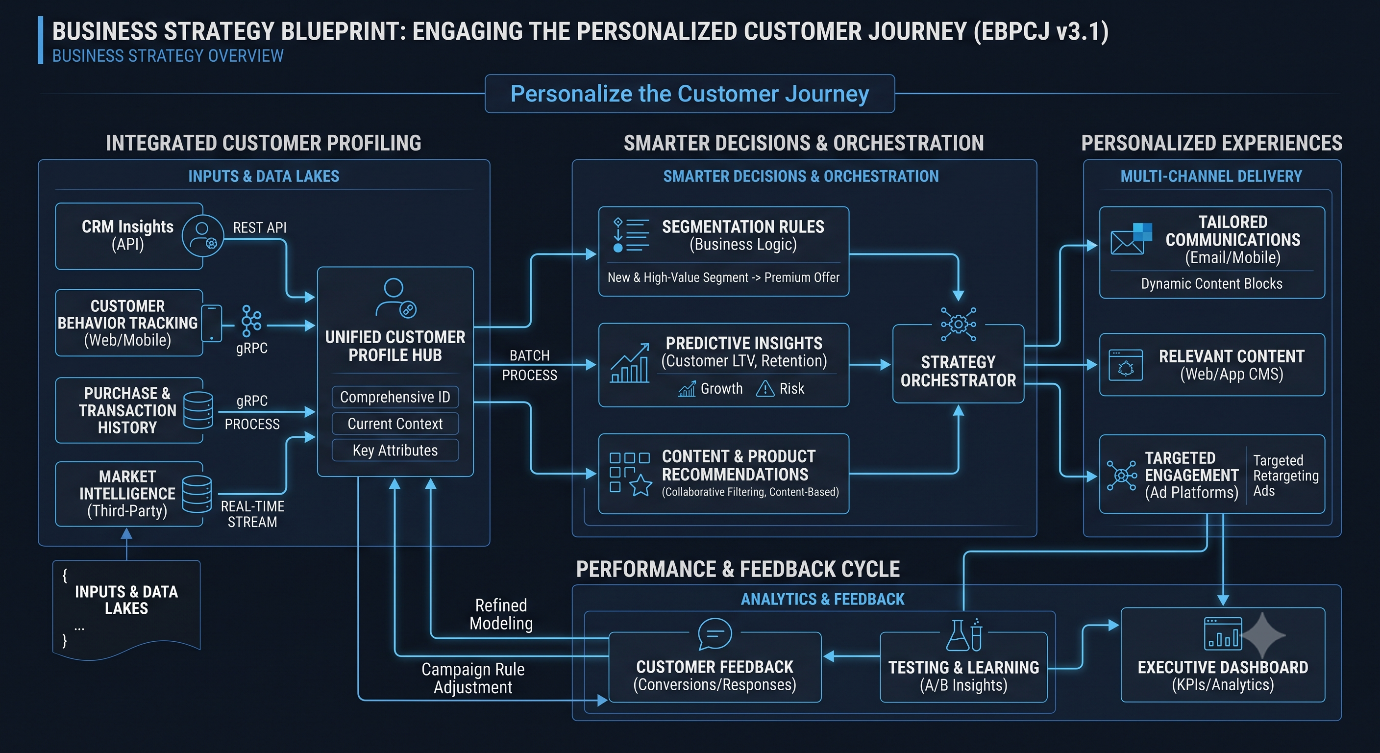
Turning "personalize the customer journey" into something an engineer can actually build.
Someone has to convert the idea into a clear business case with a specific outcome, identify the legacy systems and data limitations that will get in the way, and decide what gets built first.
A useful approach is evaluating ideas on impact versus effort — and being honest about where each one lands. Most ideas are neither urgent nor high value, and saying so upfront is fine.
The pitfall here is analysis paralysis: writing detailed business cases that never turn into progress. Keep them light early on and test assumptions with a quick proof of concept before committing to a full-scale plan.
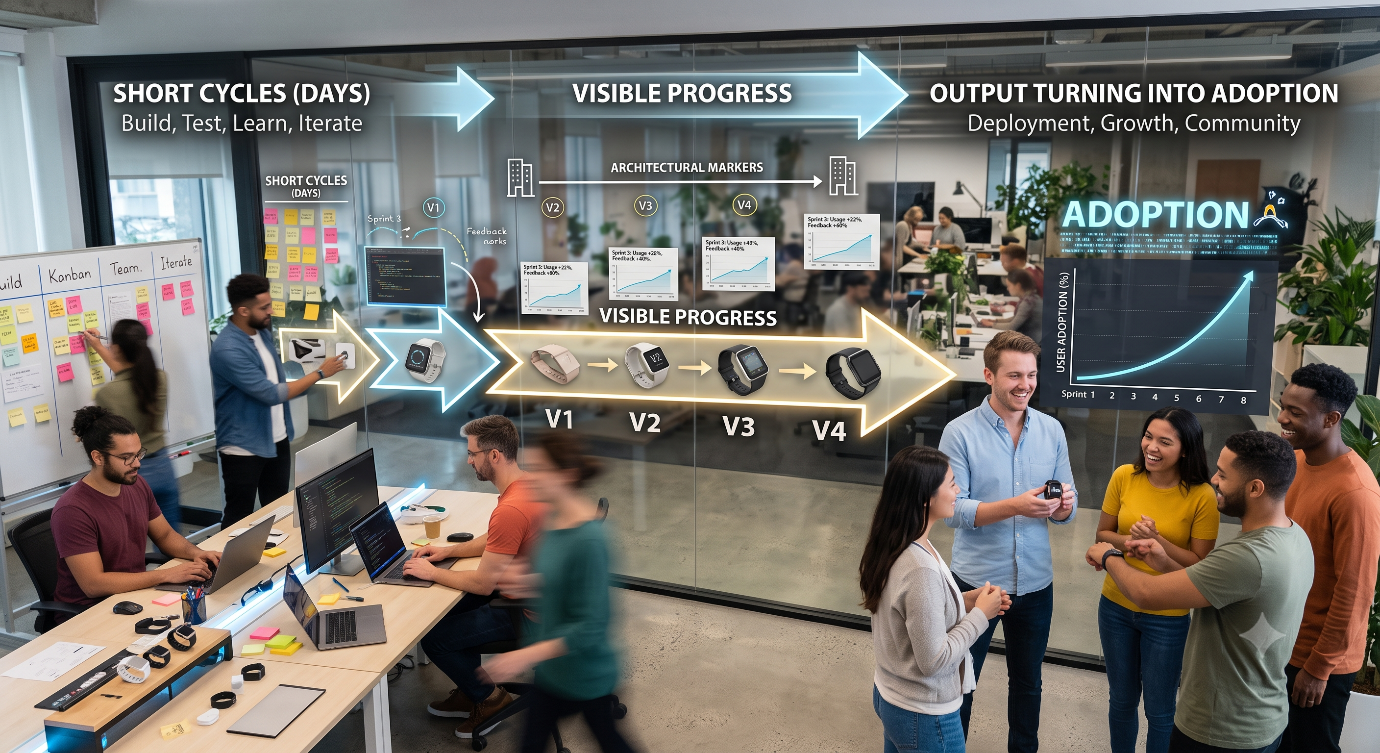
Short cycles, visible progress — output turning into real adoption.
Execution: Where the Work Actually Happens
Once an idea has a clear plan, it moves into the build phase. Software gets written, processes get updated, and people get trained on new ways of working.
Three factors determine whether execution produces real change:
- Short cycles instead of one large launch several months out.
- Change management — training, communication, and leader buy-in — treated as seriously as the code, because a feature nobody uses transforms nothing.
- Continuous measurement of adoption and impact against the metrics set during Translation, not just whether the task was completed.
The main trap is confusing output with outcome. Delivering a feature on time is output. Most employees actually using it and processing time dropping by half is the outcome. Only one of those is worth celebrating.
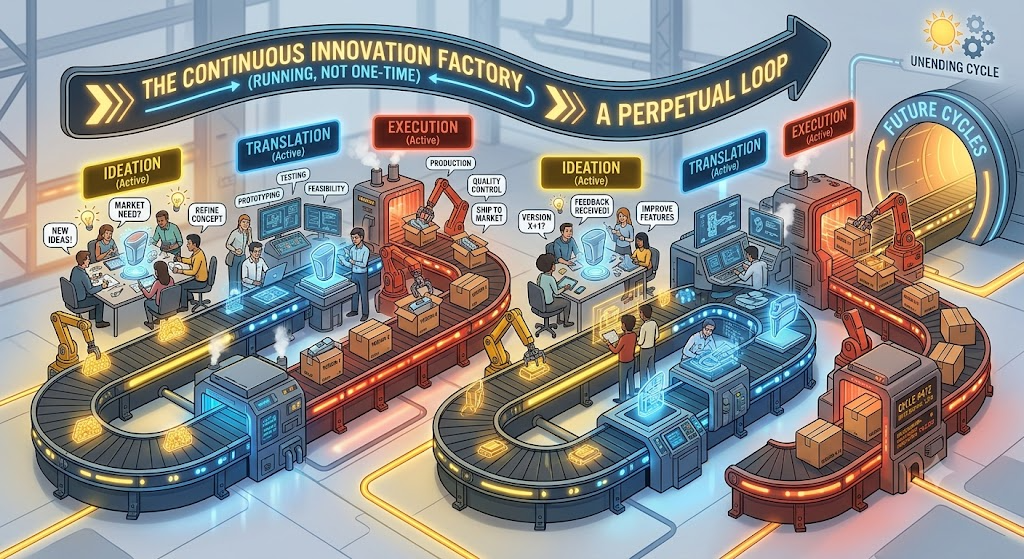
The factory-line metaphor but running — not three phases done once.
The Loop That Makes It Work
The three stages are not a linear process that happens once.
What you learn during Execution — a solution nobody expected, or a feature that goes unused — feeds back into Translation to correct course, and often kicks off a new round of Ideation as teams surface new problems.
That feedback loop is what makes the system work. A company that treats transformation as three steps done once ends up with a collection of case studies and no ongoing progress. A company that keeps the loop running builds something that keeps improving.
What This Looks Like in a Real Delivery Process
The three buckets are not abstract. They map closely onto the stage-gate process most product and engineering teams already run.
| Bucket | Delivery Stages | What Happens There |
|---|---|---|
| Ideation | Strategy & Roadmap, Research & Prioritization | Business goals are set, customer feedback is gathered, personas and prioritized features are identified. |
| Translation | Refinement & Product Backlog, Sprint Planning | Epics, user stories, and acceptance criteria turn the roadmap into something a developer can work on. |
| Execution | Development, UAT & Business Validation, Production Release, Operations | Code is written, tested, released, and kept stable in production. |
The ninth stage — Feedback & Continuous Improvement — is where the loop closes. Retrospectives and adoption analytics don't fit neatly into one bucket: roadmap updates return to Ideation, and the improvement backlog feeds back into Translation. That is not a metaphor — it's the actual handoff that keeps transformation moving instead of stopping after one cycle.